Cycling Kit for 45 to 60 Degree Mornings: The Hardest Range to Dress For
Quick Answer: The 45-60F band is hard because you generate heat unevenly across a ride. The solution is removable pieces rather than a heavier jersey: a base layer, a standard jersey, arm warmers, a packable vest, and full-finger gloves. Dress so you are slightly cold for the first five minutes - if you are comfortable standing at the door, you will be overheating within fifteen minutes of riding.
There is a specific temperature range every cyclist gets wrong. Above 65F you just ride. Below 40F you commit to winter kit. Between those, you leave the house wrong roughly half the time. Here is the system that removes the guesswork.
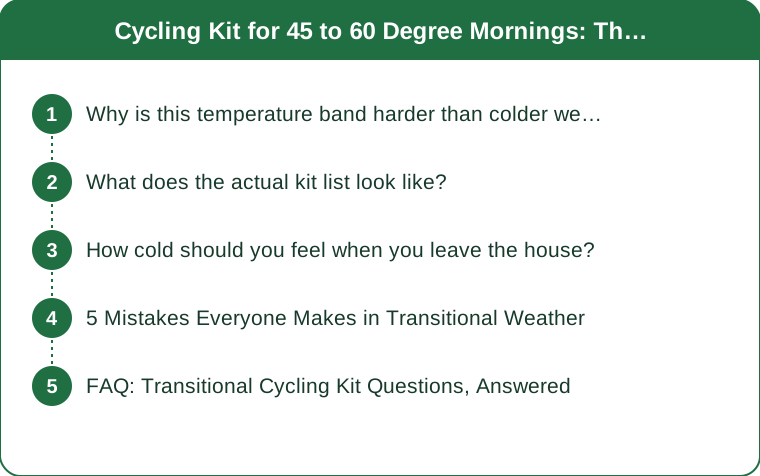
Why is this temperature band harder than colder weather?
Because your heat output changes dramatically across a ride and the air does not.
At the start, you are cold, stationary, and producing almost no heat. Ten minutes in, you are working, and a cyclist at moderate effort produces a substantial amount of heat - most of which has to be dumped through the skin. Then you crest a climb, stop pedaling, and descend at 25 mph into windchill with a sweat-soaked base layer.
The wind chill effect on a bike is the underappreciated part. At 20 mph in 50F still air, the effective temperature at your skin is meaningfully lower. On a descent at 30 mph, colder still. So a single ride at a nominal 52F actually spans an effective range of roughly 40F to 65F, and a single garment cannot cover that.
Below 40F this problem shrinks because you are wearing enough insulation that the swing matters less, and you are probably not descending at speed for very long. Above 65F it shrinks because you never get genuinely cold.
Which is why the answer is never a warmer jersey. It is pieces that come off and go back on without stopping.
What does the actual kit list look like?
Base layer - a thin, close-fitting synthetic or merino sleeveless or short-sleeve base. This is the piece most riders skip and it does more than any other item in this range. Its job is moving sweat off the skin so that the descent does not chill you. Merino is better when the ride includes long stops.
Standard short-sleeve jersey - the same one you wear in summer. Do not switch to a long-sleeve thermal jersey in this range; it commits you to a fixed insulation level.
Arm warmers - the highest value item in transitional cycling. They roll down to the wrists or come off entirely into a pocket in under thirty seconds, and they add roughly the warmth of a long-sleeve without the commitment. Get ones with silicone grippers at the bicep so they stay put.
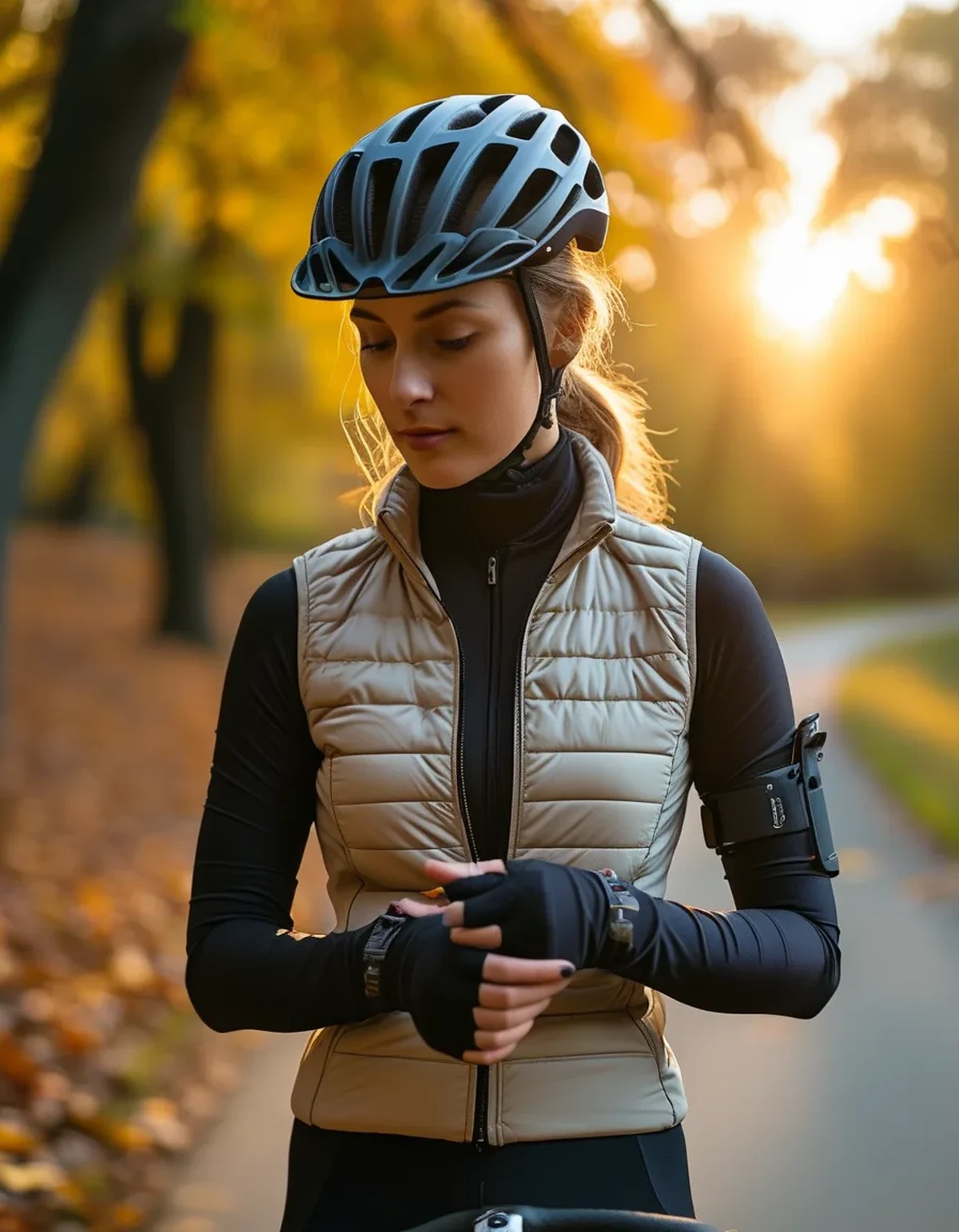
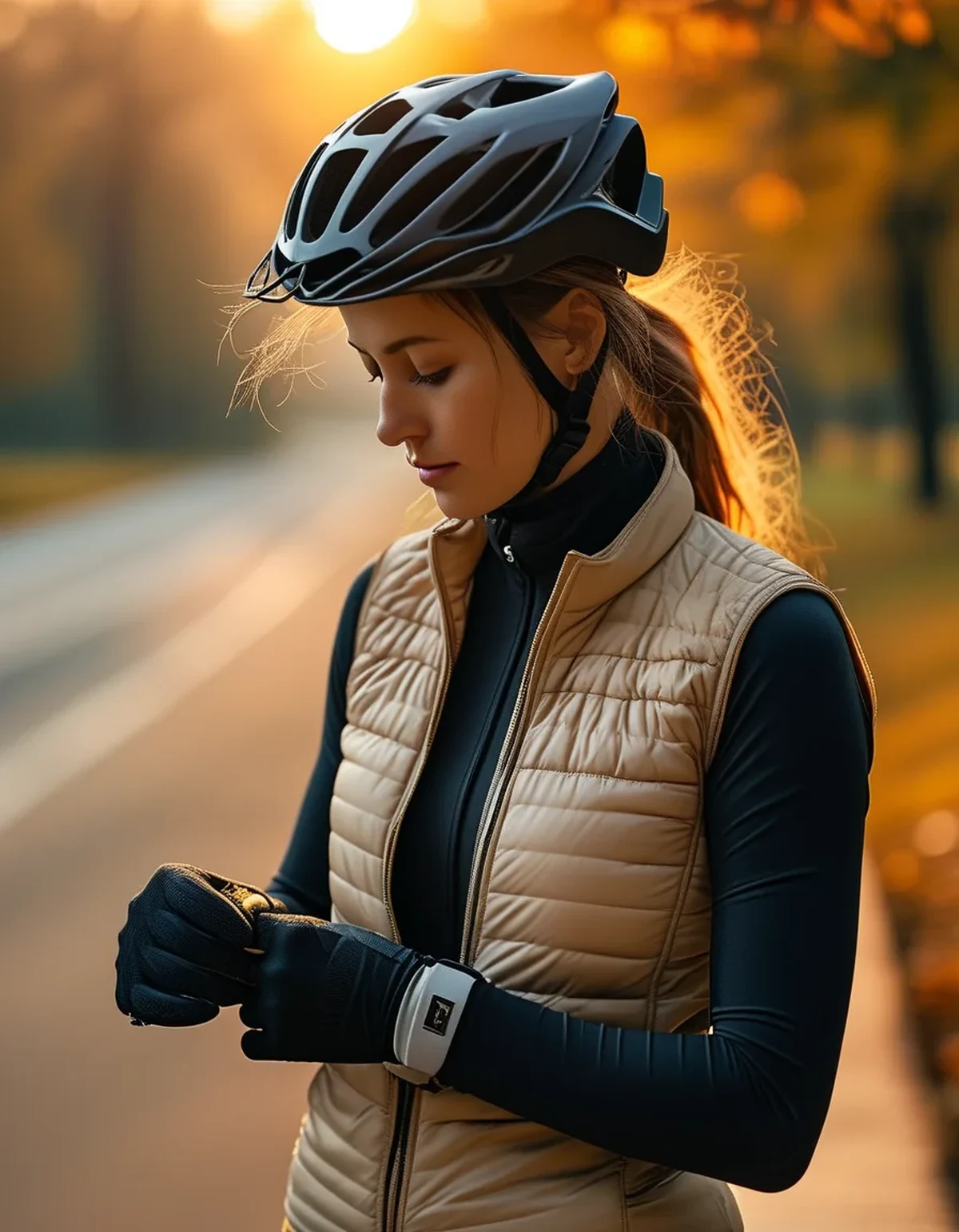
Packable vest (gilet) - wind protection over the core, open under the arms. This is what makes a 48F start survivable and packs to the size of a fist. A wind-front vest with a mesh back is the specific tool for this job.
Full-finger gloves - hands go numb long before the rest of you feels cold, and numb hands mean poor braking control. Lightweight full-finger, not winter gloves.
Optional but useful: knee warmers below about 55F, a thin cap under the helmet, and toe covers - feet are the other place that gets cold disproportionately because they are stationary in the airstream.
How cold should you feel when you leave the house?
The rule most experienced riders converge on: dress so you are slightly uncomfortable standing outside for the first five minutes.
If you step out and feel pleasantly warm, you are overdressed and you will be sweating by mile five. And sweat in this temperature range is not just uncomfortable - a soaked base layer under a windproof vest on a descent is how a pleasant ride becomes genuinely cold.
A workable set of starting points, adjusting for personal tolerance and effort level:
- 58-65F: jersey and shorts, arm warmers in a pocket just in case.
- 52-58F: jersey, arm warmers on, vest in a pocket, light gloves.
- 45-52F: base layer, jersey, arm warmers, vest on, full-finger gloves, knee warmers.
- 40-45F: everything above plus toe covers and a cap, and consider a thermal jersey instead of the vest.
Adjust for the ride profile, not just the temperature. A ride with a long climb followed by a long descent needs more removable layers than a flat ride at the same temperature, because the heat output swings further. A group ride with regular stops needs more insulation than a solo effort at the same pace.
And adjust for the direction. If you ride out with a tailwind and back into a headwind, the return leg is effectively colder even if the thermometer has risen.
5 Mistakes Everyone Makes in Transitional Weather
1. Wearing a thermal jersey instead of layers. You cannot take off a jersey mid-ride. Every piece of your kit in this range should be removable without dismounting or should regulate itself.
2. Skipping the base layer because it seems like extra warmth you do not need. A base layer’s primary function here is moisture management, not insulation. Riding without one in 50F and then descending is how people get properly cold.
3. Forgetting that the pockets have to hold what comes off. Arm warmers, a vest, and gloves all have to fit somewhere. Check that your jersey pockets have room before you commit to a layering plan that produces three items at mile twelve.
4. Dressing for the start of the ride instead of the coldest part. The coldest you will be is usually the last descent, when you are tired, damp, and no longer producing peak heat. Pack for that moment, not for the moment you leave.
5. Neglecting the extremities and over-insulating the core. Hands, feet, and ears account for a disproportionate share of how cold a ride feels. A vest plus full-finger gloves plus a cap will make you more comfortable than a thermal jacket with bare hands, and weighs a fraction as much.
FAQ: Transitional Cycling Kit Questions, Answered
Are arm warmers or a long-sleeve base layer better?
Arm warmers, in this range, almost every time - they come off. A long-sleeve base layer is better below about 45F when you know you will want it all ride. Some riders run both in the 40s.
Do I need a cycling-specific vest or will any windbreaker do?
A cycling vest is cut long at the back, short at the front, and has no sleeves to flap. A regular windbreaker will billow, ride up when you get into the drops, and trap sweat. If you only buy one transitional item, buy the cycling vest.
What about bib shorts versus bib tights in this range?
Most riders stay in shorts down to about 55F, add knee warmers from 55 down to 45, and switch to full tights below that. Knees are the joint that tolerates cold worst, so err toward covering them.
How do I stop my hands going numb even in gloves?
Check two things before buying warmer gloves: whether your gloves are tight enough to restrict circulation, and whether your bar position is putting sustained pressure on the ulnar nerve at the base of the palm. Numbness with warm hands is a pressure problem, not a temperature one.
TL;DR:
- The 45-60F band is hard because your effective temperature swings ~25F across a single ride.
- Build from base layer + jersey + arm warmers + packable vest + full-finger gloves, not a warmer jersey.
- Leave the house slightly cold. If you are comfortable standing still, you are overdressed.
- Pack for the last descent, not the first mile, and protect hands and feet before adding core insulation.
Get this system dialed in once and the entire autumn opens up. The riders still out in November are rarely the toughest ones - they are the ones with arm warmers in a jersey pocket.
Keep Reading
This article is for general informational and styling purposes only. Fit, sizing, and product availability may vary.