What Changes in Your Cycling Kit When Mornings Drop Below 15C
Quick Answer: Around 15°C (59°F) is where summer kit stops working on the bike, because wind chill at riding speed makes the effective temperature far lower. The three pieces that cover most of autumn are arm warmers, a packable gilet, and knee warmers — all of which stow in a jersey pocket.
Cycling has a specific problem other sports do not: you generate your own wind, constantly, and it never lets up.
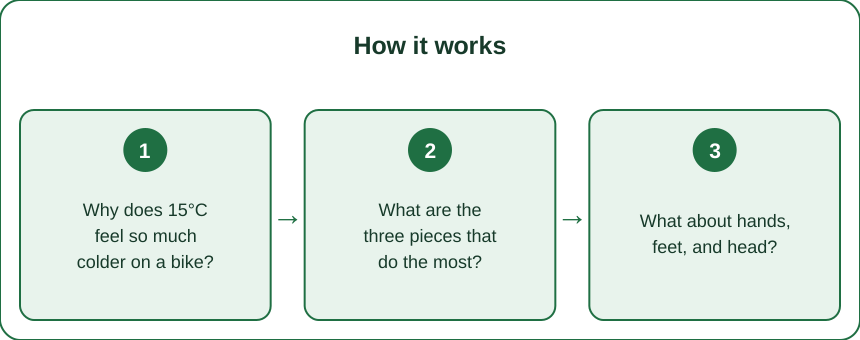
Why does 15°C feel so much colder on a bike?
Because of apparent temperature at speed. Riding at 30 km/h in still air creates a 30 km/h wind against you. Add any headwind and it climbs further.
The effect is not subtle. At 15°C with a 30 km/h relative wind, the effective temperature on exposed skin is meaningfully lower — and that is before you factor in a descent, where you stop producing heat and increase speed at the same time.
Descents are where autumn rides go wrong. You climb, you sweat, you crest the hill, and then you spend eight minutes at 50 km/h with wet kit and no heat production. The temperature has not changed; your situation has completely.
This is also why the standard advice to dress for 10 degrees warmer than the air holds well for running and poorly for cycling. On a bike, dress for the descent, not the climb.
What are the three pieces that do the most?
In order of value per gram carried:
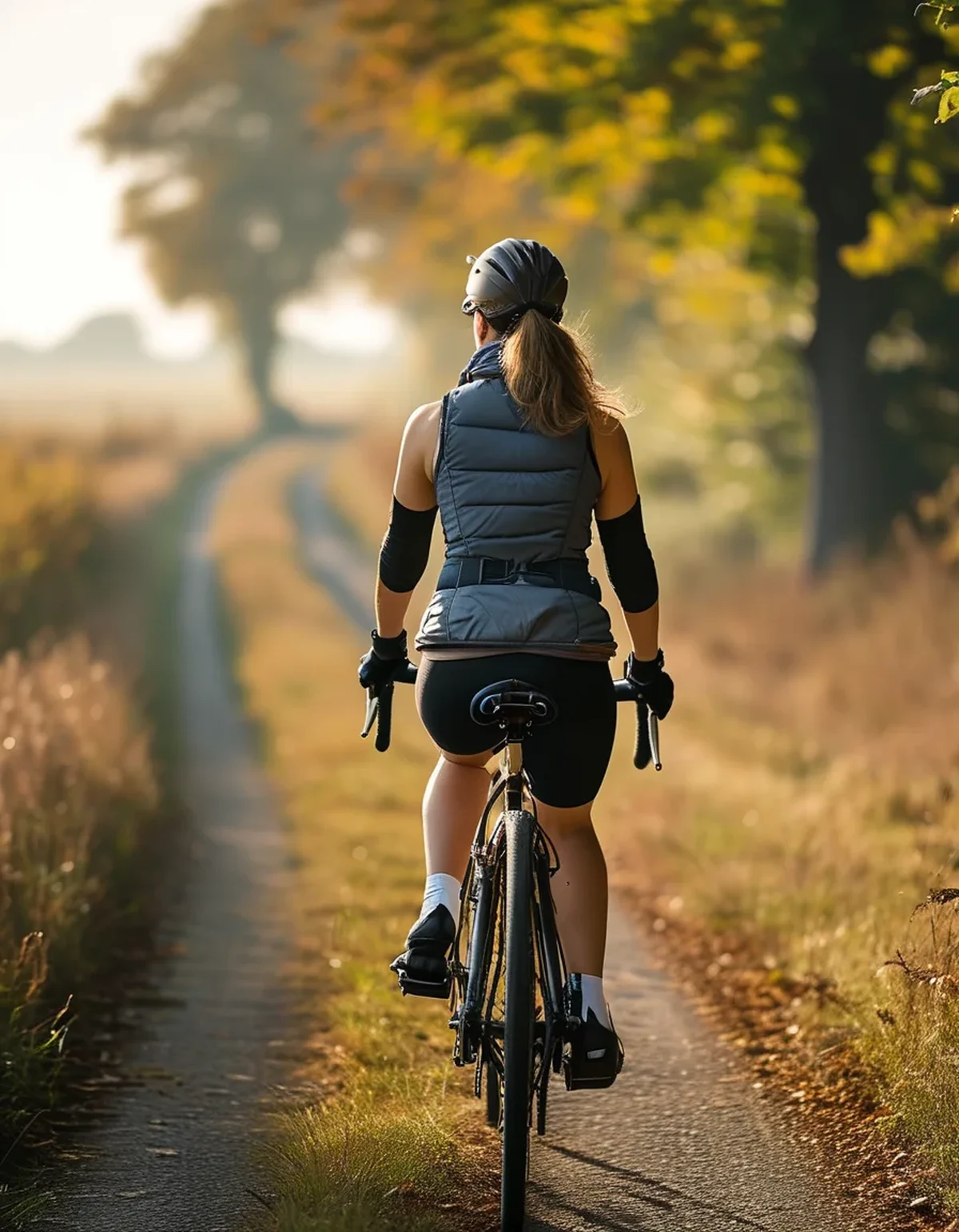
Arm warmers. The highest-return item in cycling. They turn a summer jersey into an autumn one, they roll down or come off entirely mid-ride without stopping properly, and they take almost no pocket space. Get a pair that grips at the bicep without cutting in.
A packable gilet. A wind-resistant vest protects the core and the chest — where wind chill matters most — while leaving the arms free to dump heat. It packs to about the size of a fist. For most autumn rides, jersey plus arm warmers plus gilet covers 12-18°C completely.
Knee warmers. Knees are the part of the body most worth keeping warm on a bike, and they are directly in the airflow. Common cycling wisdom puts the threshold around 15°C for covering knees, and it is one of the few pieces of traditional advice with a reasonable rationale behind it.
All three fit in one jersey pocket together, which is the point. They give you four or five distinct configurations from one kit.
What about hands, feet, and head?
These are the extremities that ruin rides, and they are cheap to solve.
Hands. Fingers go first because they are in the airflow, gripping, and not moving much. Long-finger lightweight gloves from about 14°C. If your hands go numb in mild conditions, check bar tape thickness and hand position too — pressure on the ulnar nerve produces numbness that people mistake for cold.
Feet. Cycling shoes are heavily vented and sit directly in the wind. Toe covers are the cheapest meaningful upgrade in autumn cycling — a few pounds, they live in a pocket, and they cover the vents that are the actual problem. Full overshoes from around 10°C.
Head. A thin cap under the helmet, or a headband over the ears. Ears are the part that hurts first on a cold descent.
Neck. A light neck gaiter can be pulled up on descents and down on climbs, which makes it one of the most adjustable items you can carry.
Together, these four cost less than a jersey and make more difference than one.
Myth vs Fact: autumn cycling kit
Myth: A winter jacket is the sensible purchase in September. Fact: A proper winter jacket is too warm for most autumn riding and you will overheat on climbs. Layers you can adjust beat a single warm garment for the whole transitional season.
Myth: You should be warm at the start of the ride. Fact: You should be slightly cold for the first ten minutes. If you are comfortable in the driveway, you will be sweating within two miles, and wet kit is what makes you cold later.
Myth: Waterproof is the priority in autumn. Fact: Wind resistance matters more for most rides. A fully waterproof jacket over a working body traps sweat. A breathable wind layer handles the majority of autumn conditions better.
Myth: Bib shorts plus leg warmers is the same as bib tights. Fact: Close, and more versatile, because you can remove the warmers. Bib tights are warmer and better for sustained cold, but the modular version covers a wider temperature band.
Myth: Lights are a winter thing. Fact: Sunrise is moving later by a couple of minutes a day from late August. The morning ride that started in daylight in July starts in half-light in October, and low autumn sun creates genuinely poor visibility conditions for drivers.
How do you pack for a ride with a 12-degree swing?
The classic autumn ride: 11°C at the start, 20°C by the time you finish, and a long descent in the middle.
Wear: summer bib shorts, summer jersey, arm warmers, knee warmers, long-finger gloves, cap.
Pack in the pockets: gilet, toe covers if it is below 12°C, and a light neck gaiter.
The adjustment sequence:
- First 15 minutes: everything on. You should feel slightly cool, not warm.
- After warming up: roll arm warmers down to the wrists rather than removing them. Faster, and they are there for the descent.
- Before a long descent: gilet on, neck gaiter up, arm warmers back up. Do this before the descent, at the top, not three minutes into it when your hands are already cold.
- Last third of the ride: knee warmers can usually come off if the temperature has risen.
The habit that separates comfortable autumn riders from cold ones is stopping for thirty seconds at the top of a climb to add a layer. It feels like wasted time and it is the difference between enjoying the descent and enduring it.
TL;DR:
- Wind chill at riding speed makes 15°C feel far colder, and descents are where it bites.
- Arm warmers, a packable gilet, and knee warmers cover most of autumn and fit in one jersey pocket.
- Toe covers and long-finger gloves are the cheapest fixes for the parts that actually ruin rides.
- Prioritise wind resistance over waterproofing, and be slightly cold for the first ten minutes.
- Add layers at the top of the climb, not partway down the descent.
Autumn is arguably the best riding of the year — quiet roads, good light, comfortable temperatures once you are moving. The kit is not expensive and it packs into a pocket, which makes it one of the better returns on a small spend in any sport.
Keep Reading
This article is for general informational and styling purposes only. Fit, sizing, and product availability may vary.