Why Do Cycling Shorts Turn See-Through Over Time, and What Actually Fixes It?
Quick Answer: Cycling shorts turn see-through mainly from repeated stretching and friction breaking down the fabric’s fiber density over time, a process accelerated by high heat in washing or drying, sun exposure, and lower-quality fabric blends with less spandex — the fix is washing in cold water, air drying, and doing a quick daylight stretch-test on new shorts before relying on them for a bright outdoor ride.
This isn’t just a quality complaint — it’s a predictable fabric breakdown process that gets worse the more the same fabric spots get stretched.


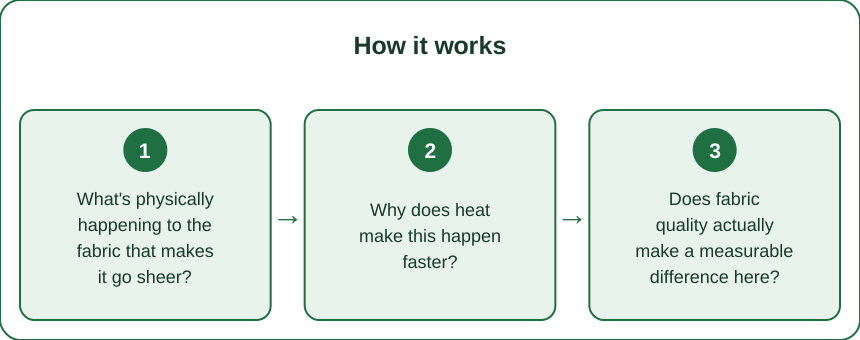
What’s physically happening to the fabric that makes it go sheer?
Repeated stretching gradually pulls fibers apart at a microscopic level, thinning the fabric’s fiber density in high-stress zones like the seat and thighs, and once fiber density drops below a certain point, light passes through more easily, which is what reads as ‘see-through’ to the eye.
Why does heat make this happen faster?
High heat from hot washing or machine drying breaks down spandex fibers specifically, which are what give the fabric its recovery and density, so heat exposure accelerates the same thinning process that stretching causes on its own, compounding the effect significantly over repeated hot wash-and-dry cycles.

Does fabric quality actually make a measurable difference here?
Yes — cycling shorts with a higher spandex or elastane percentage (typically above 15-20%) tend to hold fiber density longer under repeated stretching than lower-spandex blends, which is part of why cheaper cycling shorts often go sheer within a single season while higher-spandex-content pairs last multiple seasons.
5 Mistakes That Speed Up Sheerness
1. Washing in hot water instead of cold. 2. Machine drying with heat instead of air drying. 3. Buying based on color alone without checking spandex percentage on the label. 4. Skipping a daylight stretch-test before a bright outdoor ride. 5. Wearing the same pair for every ride instead of rotating between two or more pairs to spread out wear.
FAQ: Cycling Shorts Sheerness, Answered
Is there a reliable way to test shorts before wearing them outside?
Yes — stretching the fabric over your hand or knee in bright daylight before a ride shows whether it’s already thinning, which is a quick and reliable at-home test.
Does a chamois liner reduce sheerness risk in the seat area?
Not directly, since the liner sits inside the shorts rather than changing the outer fabric’s density, though it does reduce friction-related wear over time.
Once shorts start going sheer, is there any way to reverse it?
No, fiber thinning isn’t reversible, so at that point the shorts are due for replacement, ideally paired with better wash habits for the next pair.
TL;DR:
- Sheerness comes from repeated stretching thinning fiber density over time
- Heat from washing and drying accelerates spandex breakdown significantly
- Higher spandex percentage fabric holds density longer under the same wear
- A quick daylight stretch-test before a ride catches the problem before it’s embarrassing
Sheerness is a predictable fabric fatigue process, not bad luck — cold washing, air drying, and rotating pairs meaningfully extends how long shorts stay fully opaque.
Keep Reading
This article is for general informational and styling purposes only. Fit, sizing, and product availability may vary.